
Comunidade Urbana
Comunidade Urbana
Photos By Kevin Harkins
Available for Advance Orders
Publication date is February 1, 2027
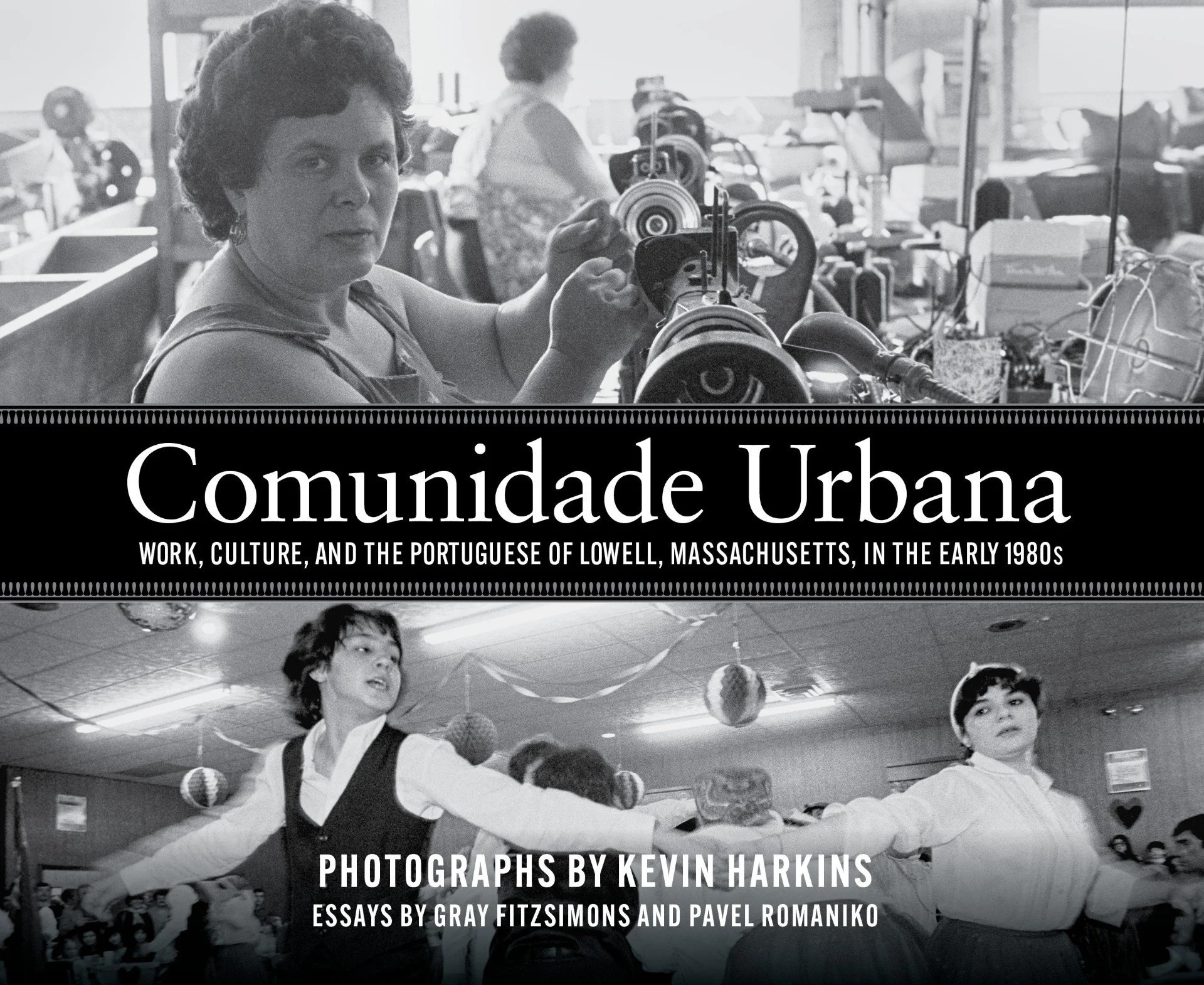
A photo-documentary of 80 images by Kevin Harkins of the Portuguese people of Lowell, Massachusetts, at work and in their community in the early 1980s. Produced by the Saab Center for Portuguese Studies at the University of Massachusetts Lowell, in collaboration with Loom Press, this is a rare study of the occupational culture and neighborhood life of a significant ethnic group in the historic textile mill city whose story is preserved and told by Lowell National Historical Park, U.S. Dept. of the Interior. The book includes essays by historian Gray Fitzsimons about the Portuguese community in Lowell and by artist and professor Pavel Romaniko of U Mass Lowell about the photographs.
I grew up in Lowell, in a Portuguese family that knew these mills from the inside. After moving to Lowell from the Azores, my grandmother spent her days on a textilemill floor. My grandfather, from Porto, worked as a carpenter. They crossed an ocean for a better life and built one here, so their children and grandchildren could live the life they came here dreaming of. Comunidade Urbana tells that story, one of a generation of Portuguese men and women who kept this city running and rarely got the credit. Preserving their stories is how we honor them and how we show future generations exactly where they come from.
—U.S. Representative Lori Trahan, the first Portuguese American Congresswoman
The Portuguese, a highly significant but often overlooked ethnic group in Lowell, finally receive much-deserved attention in these evocative photographs taken in the early 1980s, the twilight years of the city’s once-mighty industries. Through text and images, this volume offers a glimpse into the lives, culture, and workplaces of those who were part of the last great wave of European immigration to American cities.
—Patrick Malone, Professor Emeritus of American Studies and Urban Studies at Brown University and author of Waterpower in Lowell
As the child of Portuguese immigrants from the Azores, I have made Lowell my home for nearly sixty years. During this time, I graduated from high school and college, pursued a career, married my husband Paulo, bought a home, and raised three sons. Comunidade Urbana evokes deeply personal feelings. The Harkins photographs depict the story of hardworking men and women who came to Lowell seeking a better life for their families and future generations.
—Maria (Espínola) Cunha, educator and community activist, Lowell
Artist Statement
I’ve been looking at Lowell forever. My whole life. My ancestors go back generations here. No matter how familiar I feel I am when it comes to the people and places in the city, there’s always something new and different—and often it’s a view or a person or an experience that winds up changing my understanding of the city. I love that part of my work as a photographer.
I’ve had a camera in my hands since I was twelve years old and was tasked with photographing my dad’s various civic activities at sixteen. As a photographer, I’m required to pay attention, to look more closely than the average person, to notice what others might miss. It comes down to the difference between looking and seeing. In more than forty years looking through the viewfinder, I’ve learned that I’ll always see something new. That process took a giant step forward in 1981 when I was fresh out of the Art Institute of Boston and given a chance to do a deep photographic dive into one of the significant immigrant communities in my hometown.
That year, Barbara Dunsford, the program director of the Lowell Union of Portuguese Americans (LUPA), secured several grants to support the organization’s social services for Portuguese residents in the area. One of those grants funded a community documentation project for which I was hired as the photographer. The grant was awarded by the Lowell Historic Preservation Commission, U.S. Department of the Interior, a federal agency collaborating with the National Park Service on the physical and cultural development of the new Lowell National Historical Park. With the coming of the National Park Service, everything in Lowell got bumped up in national importance. Instantly, we were examples of larger American themes like immigration and industrialization.
For the commission, I was charged with documenting the working lives and neighborhood experiences of the Portuguese community living around Back Central Street. This required gaining access to shops, factories, and businesses where community members worked, while also tracing their lives beyond the workplace.
I captured activities behind the scenes and the actual scenes themselves, whether shooting at Carol Shoe, Commodore Foods, Joan Fabrics, or Wang Laboratories. Not every company welcomed my camera. My attitude was to gain access and just photograph. The camera could be a shield if needed and a passport at times. Holding a Nikon camera in my hands sent the message to people that I was a real photographer. It was a professional badge.
I covered a lot of territory. I roamed the Back Central neighborhood capturing the Portuguese working in their shops or enjoying a summer night on the front stoop while kids played in the street. Several times I photographed their events and soccer games at Holy Ghost Park across town, a popular performance and gathering space. When I had enough contact sheets to show to Barbara, she’d share them with the LUPA board of directors, who would then suggest new subjects and locations for me to visit.
Upon the completion of the project, I felt fulfilled. I was happy with the results of my efforts and grateful to Barbara and LUPA for the opportunity to be part of this project. Forty-five years later, I found that age and time have added to the value of the views. Thank you to Frank, Gray, Pavel, and Paul for helping to resurrect these images from my archive.
As far as I know, there is no comparable body of photographic work from the 1980s that documents Portuguese Lowellians at work and as a community in the same depths that my access afforded. It’s true that there is always change over time. Photography in its way encapsulates events. In these images we have an extended moment at a time when the demographics, culture, and economy of the city were changing. After decades of decline in the old mill town, opportunities were opening up. There was even talk of the Massachusetts Miracle with high technology expanding. Some of the Portuguese people in Back Central were getting a foot on that high tech ladder. At the same time, normal neighborhood life continued as it always had: the small businesses, the guy selling fish off the back of a truck, local gardeners with vegetable stands, churchgoers, and others went about their daily routine.
I’m proud to have embarked on this LUPA project. The result is a rare accounting of a significant Portuguese population in New England. I hope you enjoy what is preserved in the following pages.
Kevin Harkins